
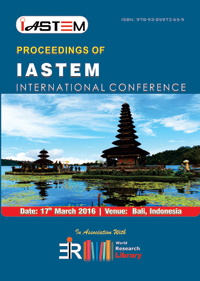
16TH IASTEM INTERNATIONAL CONFERENCE
Bali, Indonesia 17-03-2016
ISBN 978-93-85973-65-9
10 papers
-
Infuluence Of Laboratory Short Term Aging On Tensile Strenght Of Porous Asphalt Mixture Containing Buton Granular Asphalt
Mohammad Rizal, Tjaronge M. W., Nur Ali, Taslim Bahar
Paper ID IA-ICCAEINDO-16036-1141 · Pages 1-4
Download PDF: Infuluence Of Laboratory Short Term Aging On Tensile Strenght Of Porous Asphalt Mixture Containing Buton Granular AsphaltAbstract
This study purposes to study the influence of laboratory short term aging on the tensile stress-strain relationship of porous asphalt concrete mixtures using Buton Granular Asphalt (BGA) as partial replacement for petroleum asphalt. The experimental tests show that the Indirect Tensile Strength-vertical strains curve were similar for all mixtures. The application of BGA as partially replaced petroleum asphalt in the porous asphalt mixture improved the tensile strength and elastic modulus in comparison to porous asphalt mixture without BGA. Keywords— Porous Asphalt, Buton Granular Asphalt, Tensile Strength, Strain, Stress.
-
Experimental Study On Stability Of Emulsion Asphalt Mixture Made With Extracted Bitumen Of Buton Natural Rock Asphalt (EB-BRA)
Israil, M.W. Tjaronge, Nur Ali, Rudy Djamaluddin
Paper ID IA-ICCAEINDO-16036-1153 · Pages 5-9
Download PDF: Experimental Study On Stability Of Emulsion Asphalt Mixture Made With Extracted Bitumen Of Buton Natural Rock Asphalt (EB-BRA)Abstract
Buton natural rock asphalt (BRA) consists of 30% of bitumen and 70% of mineral. Extracted bitumen of BRA (EB-BRA) was blended with cationic emulsion, kerosene, chloride acid, calcium chloride and water to produce asphalt emulsion. Marshall specimens were used to study the stability of emulsion asphalt mixture containing EB-BRA. The test showed that the application of asphalt emulsion made with EB-BRA in the production of asphalt concrete wearing course mixture result in a proper stability. Furthermore, the increasing of curing time led to stability development and flow decline in all asphalt emulsion mixtures Keywords— Asphalt emulsion, Extracted bitumen of Buton natural rock asphalt (EBBRA), Stability, Flow.
-
Experimental Study Of Panel Precast Buton Asphalt Pavement With Strengthened By Geogrid
Sunaryo Mulyo, Herman Parung, Ahmad Bakri M, Rudy Djamaluddin
Paper ID IA-ICCAEINDO-16036-1156 · Pages 10-14
Download PDF: Experimental Study Of Panel Precast Buton Asphalt Pavement With Strengthened By GeogridAbstract
Precast buton asphalt panels with the same characteristics as the characteristics of the massive asphalt can be used as an alternative method of implementation of the asphalt pavement as an effort to simplify and reduce of implementation errors, so that it can increase the attractiveness of the use of asphalt Buton. With the results of experimental tests of the model of precast panels Buton Asphalt pavement is known that the geogrid is able to raise the Buton asphalt panel's ability to withstand a static load and increase the stiffness of the panel. This will be very beneficial related to the real conditions on the field that the pavement was often got static load like a wheel load of vehicles that are parked or load of the panel itself while in the process of transporting and stacking. The most effective is installed on a panel with a thickness of 5 cm. It is seen an increase in the percentage of the maximum static load bearing capability as well as an increase in the amount of deflection before collapse. Keyword— Buton Aspal, Precast, Panel, Geogrid.
-
Downward Accountability & Ngo Effectiveness: A Second Phase Study
Nurul Hidayana Mohd Noor, Siti Hajar Abu Bakar Ah
Paper ID IA-ICEBMINDO-17036-001 · Pages 15-19
Download PDF: Downward Accountability & Ngo Effectiveness: A Second Phase StudyAbstract
The qualitative data found in this paper was intended to validate and explain the outcomes of the first phase study which is the survey results of 209 employees. This was carried out as to elucidate the effect of downward accountability towards NGO effectiveness. We argue that the existing measures are incomplete and based from that, we develop a structural model to test the hypothesized effect. Utilizing Mango’ (2010) framework, the results have revealed that information disclosure and complaints procedures affect NGO effectiveness except for participation mechanism. Thus, in understanding those results, for the second phase study, we utilize semi-structured interview technique by collecting data from six key informants who are leaders, managers, and influential person of Malaysian NGOs. The insightful results verify and confirm the empirical model as well as provide in-depth understanding on the hypothesized relationships. Keywords— Information Disclosure, Participation Mechanism, Complaints Procedures, Non-Governmental Organization (NGO)
-
Calculation Of Persistent Organo-Chlorine Residues In A Fresh Water Fish By GLC And Find Out Their Accumulation Pattern
Ajay Srivstava
Paper ID IA-ICENSBALI-17036-01 · Pages 20-23
Download PDF: Calculation Of Persistent Organo-Chlorine Residues In A Fresh Water Fish By GLC And Find Out Their Accumulation PatternAbstract
Residues of various pesticides in a commercial fresh water catfish, Heteropneustes fossilis were measured. This study is relevant because of possible toxicological exposure to fish eaters by way of consuming such fish containing pesticides. Tissue extracts obtained by Soxhlet apparatus were used for analysis and the concentrations of analytes were determined by gas chromatography with electron capture detection.The organochlorines found in edible portion of fish (i.e.flesh) were mainly- Endosulfan, Delta-HCH, Aldrine , pp-DDE etc. The concentration of these organochlorines were at or above the theoretical threshold limit and hence are supposed to be effectively toxic to fish eaters. Keywords— Heteropneustes fossilis, organochlorines, endosulfan, hexachlorocyclo hexane (HCH), gas chromatography
-
Barriers To Implementation Of The IPad Into The K-12 Classroom
Christopher Foster, Ed.D.
Paper ID IA-ICSSHBALI-17036-03 · Pages 24-26
Download PDF: Barriers To Implementation Of The IPad Into The K-12 ClassroomAbstract
The paper will examine the potential barriers to successful iPad implementation in the K-12 classroom and the next steps in exploring successful learning experiences based on iPad use. Index Terms— iPad, Elementary, Blended Learning, Barriers to Implementation.
-
The Calibration Of Discharge Model As An Impact Of Land Use And Climate Changed In Kodina Watershed, The South Of Lake Poso
Rudi Herman, M. Saleh Pallu, M. Arsyad Thaha, Rita Tahir Lopa
Paper ID IA-ICSTMINDO-16036-02 · Pages 27-33
Download PDF: The Calibration Of Discharge Model As An Impact Of Land Use And Climate Changed In Kodina Watershed, The South Of Lake PosoAbstract
Changes in land use and climate changed had a direct impact to the flow characteristics and the availability of water in a watershed. In terms of utilization of water resources of a river or surface water, the design will be based on historical data (time history) debits. By knowing the river discharge data in the time period, it can be foreseen the magnitude of the discharge at the future. The mistakes which implied in data of rain and discharge, parameter yielded become less optimum of the models. Therefore it was required a phase calibrate to evaluate the model. Data of rain, climatology and discharge in Kodina River were enough to run the models. From two methods were applied in the calculation, It was shows the Nreca models are more similar with observed data. Therefore the calibration model was only tested the Nreca Models. The result of the calibration models shows the errors is 4.81%, coefficient correlation is 0.736, Initial SMS is 200 mm, and Nominal is 835.8 mm. After running the Nreca model, the it was calibrated and validated concerning to land use changed the model are tested again. The result of calibration shown, the maximum discharge is 33.33 m3/s while the observed data is 32.96 m3/s. The minimum debit is 2.55 m3/s and observed discharge is 3.29 m3/s. The average of discharge for the model is 6.12 m3/s while the observed data is 15.58 m3/s. Rainfall and discharge model of hydrology stream used Nreca method, with three especial parameter. Result calibrate to indicate that value of parameter to: make an index to soil moisture storage capacity (Nominal) = 835.8 mm ; PSUB = 0,91 ; Percentage of the pool of groundwater flowing into the river as the base flow (GWF) = 0.18. While correlation coefficient value (r) = 73.59 %, and number of error is 4.81. The results shows the relation of observed discharge and the model result are very close. Assess the parameter serve the purpose of assess characteristic of catchment area having an effect on to occurence of stream in DAS Kodina. Keywords— Land use, evapotranspitation, Nreca Model and Calibrations, Discharge.
-
Antimalarial Activity Of Actinodaphne Macrophylla Stem Bark
Tiah Rachmatiah
Paper ID IA-ICMBPSBALI-17036-01 · Pages 53
Download PDF: Antimalarial Activity Of Actinodaphne Macrophylla Stem BarkAbstract
Malaria is a parasitic disease that is still a public health problem in the world, including in Indonesia. The occurrence of malaria parasite resistance to antimalarial drugs adds to the problem of malaria treatment. Therefore anticipation to get new drugs is still conducted continuously. Study of Actinodaphne macrophylla (Lauraceae) has been conducted to determine its activity as an antimalarial. Stem bark of the plant used in this study were collected from Bogor Botanical Garden, West Java, Indonesia. In this study, the stem bark powder was defated with n-hexane, then was moistened with 25% NH4OH for 2 hours and macerated with dichloromethane to obtain alkaloidal extract. Antimalarial activity of the extract was conducted to in vitro test against Plasmodium falciparum and in vivo test in mice against Plasmodium berghei. The results of in vitro activity test showedthat alkaloidal extract of A. Macrophylla stem bark has IC50 of 0, 1 µg / ml and in vivo activity has ED50 of 516.66 mg / kg.
-
Rearing Of Crocidolomia Binotalis (Zeller) (Lepidoptera: Pyralidae) On The Artificial Diets
Siti Sumarmi, Tri Rini Nuringtyas, Kartini
Paper ID IA-ICMBPSBALI-17036-900 · Pages 54-57
Download PDF: Rearing Of Crocidolomia Binotalis (Zeller) (Lepidoptera: Pyralidae) On The Artificial DietsAbstract
Studies on rearing of Crocidolomia binotalis (Zeller) on different artificial diets by using insect diet recipe based on insect diet recipe from Kurihara, Jack bean diet and egg yolk Couturnix japonica (Squil) diet, and cabagge fresh leaves diet as a its natural diet. The insect rearing was conducted under controlled laboratory conditions of 27±2°C, 65 ± 5% RH, during 2015; in the Laboratory of Entomology, Faculty of Biology University of Gadjah Mada, Yogyakarta, Indonesia. The results showed that the larval stage of C. binotalis on fresh cabagge leaves diets resulted in highest percentage survival rates among all the parameters of larval stages of C. binotalis (90%). However, the use of Jack bean and quail egg yolk as artificial diets showed percentage survival rates respectively were 70% and 66 %. The pupal weighst of C. binotalis feed on jack bean and egg yolk diets were lower than feed on cabagge fresh leaves and Kurihara recipe diet. The incubation period for eggs was 4 days (range 3-6 days). The percentage of egg hatched of the insect reared on fresh cabagge leaved and Kurihara diet was 44.33- 51.67% , however eggs from imago that the larvae feed on Jack bean and eggs yolk are not hatched. The squil eggs yolk diet with improvinng some more protein engridients.is recommended to be an alternative diet for rearing larva C. binotalis coloni under laboratory conditon. Key words- Crocidolomia binotalis, cabbage, jack bean, quail egg yolks